
Outdoor Links
Hike Arizona
Trip Planning Guide
Trip Report Index
Calendar of Events
Library
Saguaro Lake, Butcher Jones Beach
March 22, 2022
by Chuck Parsons
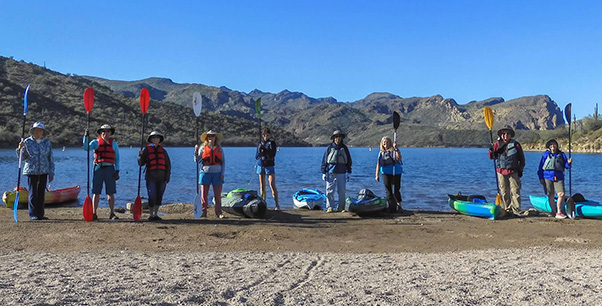 Nine Trailblazers gather by their kayaks, with Saguaro Lake in the background. [photo by Wayne] |
| Barbara, Ron, Anna, Norma, Kelley, Wayne, Diane, Chuck, Debi |
|
On a beautiful Tuesday morning in late March, nine Arizona Trailblazers meet at Butcher Jones Beach on Saguaro Lake for another great day of kayaking. The sky is clear blue without a hint of clouds, and the temperature stands at a perfect 60 degrees. The lake surface is almost as smooth as glass, with only the slightest of ripples. We couldn’t possibly have ordered up a better day for kayaking. After hauling our eight kayaks and gear down to the lake shore and prepping the kayaks for launch, we pose for a group picture, with the lake and the mountains in the background. After a round of introductions and a brief discussion about kayaking safety, including what to do in case of a capsize, at 8:30 AM we push our kayaks into the lake, climb aboard, and start paddling in the direction of the main Salt River Channel on the lake. |
 And we’re off! [photo by Wayne] |
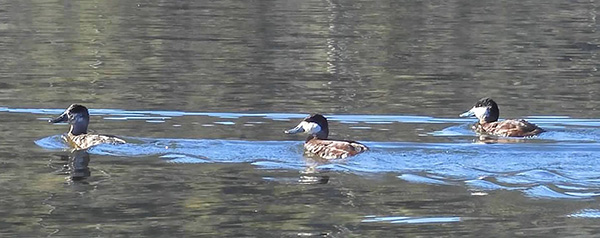 This trio of Ruddy ducks has found the perfect home. [photo by Wayne] |
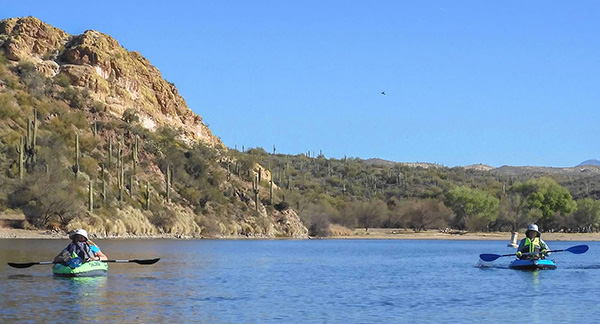 Diane and Barbara, paddling away from Butcher Jones Beach. [photo by Wayne] |
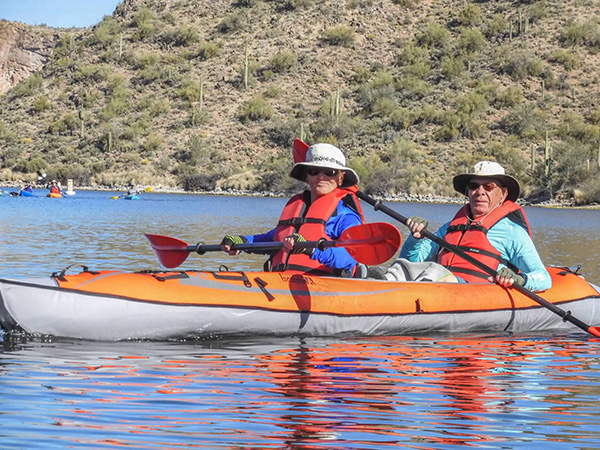 Anna and Ron in their tandem kayak. [photo by Wayne] |
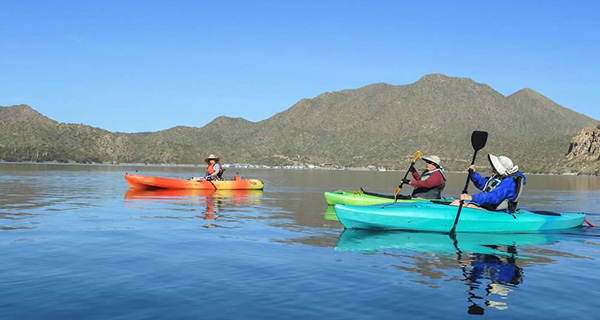 Norma, Chuck, and Debi, with the marina in the background. [photo by Wayne] |
|
From kayak trainer Lawrence’s training class a few weeks earlier on Canyon Lake, we learned that in case of a capsize the individual in the water should not even attempt to climb into someone else’s kayak, nor should anyone in a kayak let them. Such action is little more than an invitation to disaster, since the result is almost guaranteed to be two capsized kayaks and two people now in the water. Instead, the closest kayaker with a rope should throw their rope to the person in the water, have that person hold on securely, and then paddle to the shore with the individual in tow. Another option is for the capsized person to attempt to climb aboard their own kayak, if all possible. After years of hiking the Butcher Jones Trail around Saguaro Lake and launching numerous kayaks from Butcher Jones Beach, my curiosity finally got the best of me. Just who was this fellow, Butcher Jones, anyway? Is he a completely fictitious character, or was he a real meat cutting butcher, or a quack doctor who butchered some of his patients, or just a plain crackpot of some type? After many long hours of painstaking research (actually, only a few seconds, thanks to the magic of Google), this is what I came up with: |
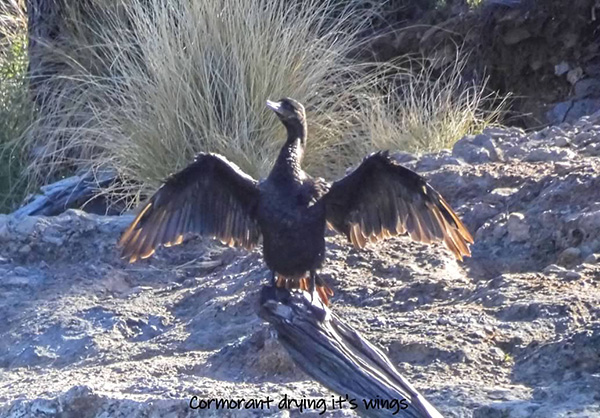 This Black-necked Cormorant is drying its wings in the sun. [photo by Wayne] |
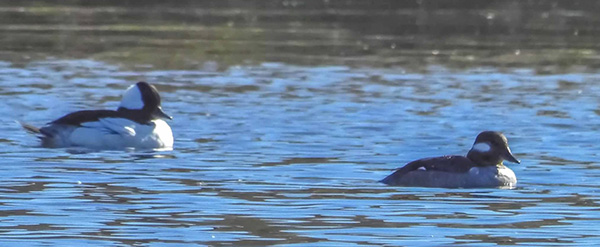 While this pair of Buffleheads swims blissfully along. [photo by Wayne] |
|
The Arizona Republic’s Scott Craven did some resent research, and here’s what he found: Butcher Jones most likely is Dr. W.W. Jones, according to state historian Marshall Trimble. An online search showed Jones to be more than a medical professional. In the mid-19th century, he also owned mines in Arizona, as well as a freighting business. He lived in Yuma, Prescott, Wickenburg, Phoenix and Tempe, and later in life became a rancher. He apparently was fairly influential in his day, and he was friends with Jacob Waltz of Lost Dutchman Goldmine fame. There also was a mention that Dr. Jones performed surgeries on his dining room table, which may have led to his nickname of Butcher (a Parks Department employee said of Butcher Jones – “I am pretty sure he was a doctor, but apparently not a very good one.”). |
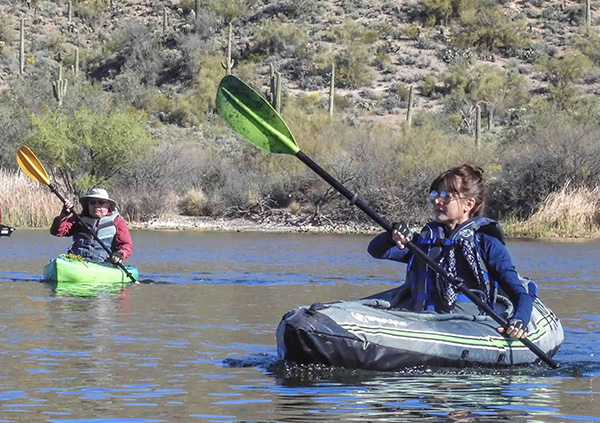 Chuck and Kelley, paddling in perfect unison. [photo by Wayne] |
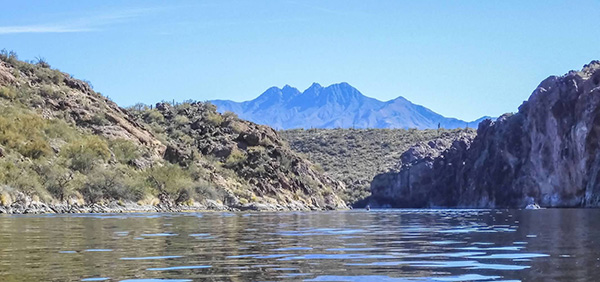 The placid surface of Saguaro Lake, with the majestic Four Peaks in the background. [photo by Wayne] |
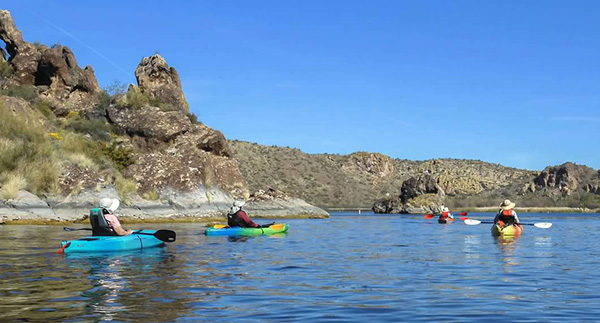 Four Trailblazers, approaching Ship Rock. [photo by Wayne] |
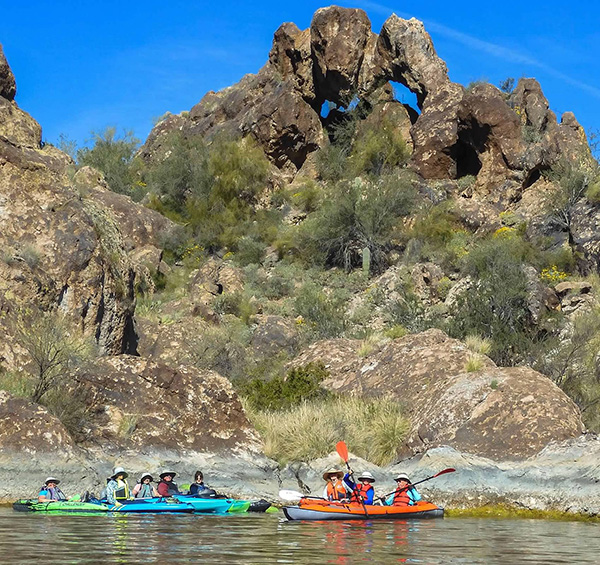 We attempt to realign our kayaks beneath the imposing Elephant Rock. [photo by Wayne] |
|
The winds remain calm as we make our way across the main body of the lake and into the old Salt River channel. For people not familiar with the Salt River Project’s series of dams and lakes on the Salt River, four concrete dams, beginning with Roosevelt Dam completed in 1911 and ending with Stewart Mountain Dam completed in 1930, were constructed on the Salt River for the dual purpose of water storage and flood control, along with the added bonus of a limited amount of hydroelectric power generation. The Salt River, now controlled by water released from Roosevelt Dam at the top of the chain, flows through Apache Lake, Canyon Lake, and Saguaro Lake, finally terminating at the Granite Reef Diversion Dam, located four miles downstream of the confluence of the Salt and Verde Rivers, before flowing into a large network of canals and delivering water to hundreds of thousands of residential, commercial, and agricultural users across the entire Metro Phoenix area, also known as the Salt River Valley. |
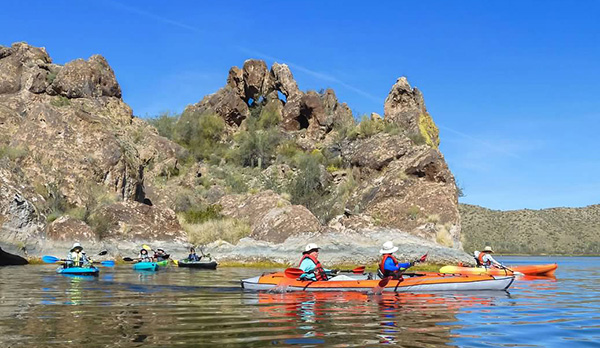 Trailblazers paddle away from Elephant Rock. [photo by Wayne] |
 Searching for a good place to beach our kayaks. [photo by Wayne] |
 The prominent danger signs and light beacon state the obvious here. [photo by Wayne] |
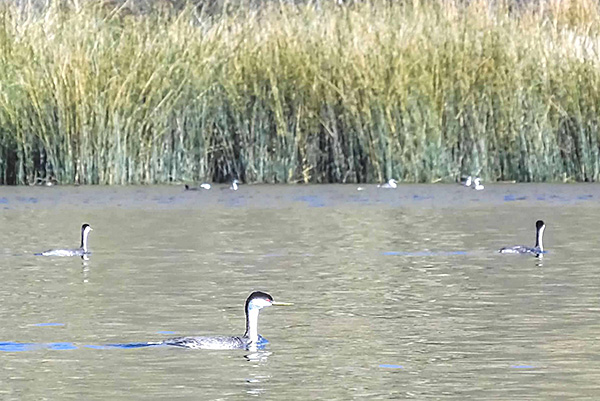 Clark’s Grebes are certainly plentiful on the lake today. [photo by Wayne] |
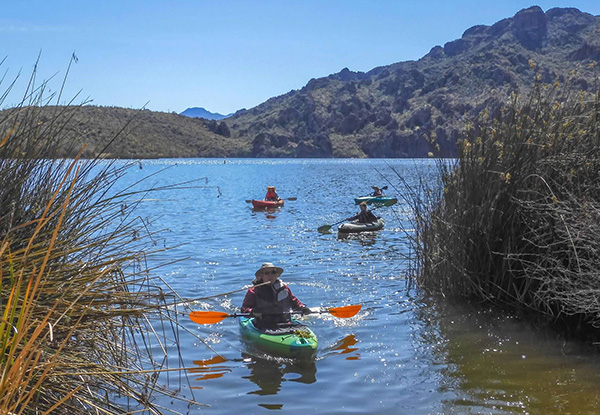 Wayne has located a good lunch spot. [photo by Wayne] |
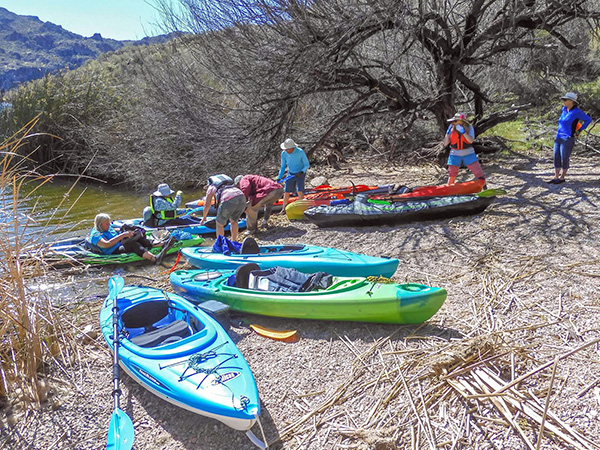 Nine kayakers pull into shore for a lunch and rest break. [photo by Wayne] |
|
We start running into more boat traffic and many other kayakers, before realizing that some schools are still out on spring break, which would account for the extra traffic. Before reaching Ship Rock, 2.5 miles from Butcher Jones Beach, we start getting buffeted by strong head winds, forcing us to dig in even harder with our paddles to keep making headway. Thankfully, though, the winds don’t last too long, and before long Ship Rock finally begins to come into view. Wayne pushes ahead, in search of a good beach area large enough to accommodate all eight of our kayaks and eventually disappears into a large reed bed, roughly a half-mile beyond Ship Rock. Tall and thick reed beds, some as high as 20 feet or more, seem to be gradually closing off more and more access to the shore along this part of the lake, making it increasingly difficult to find a good place to beach a large number of kayaks. It’s 10:30 AM by the time we beach our kayaks through this small break in the reed bed that Wayne discovers and get out to stretch tired muscles and stiff joints, before sitting back down in the soft grass for a well-deserved rest and lunch break. Watch out for ants, people! |
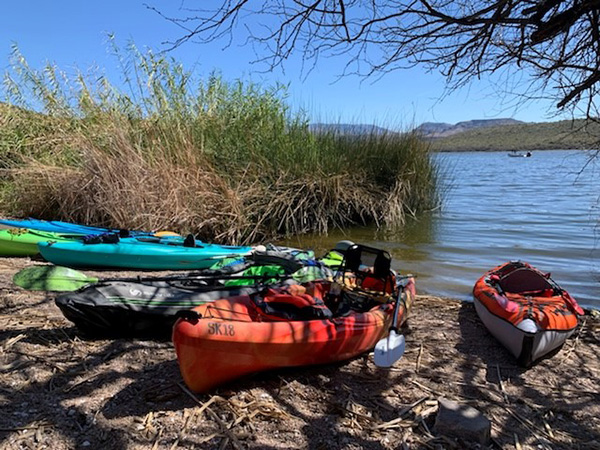 Six kayaks parked on the beach. [photo by Debi] |
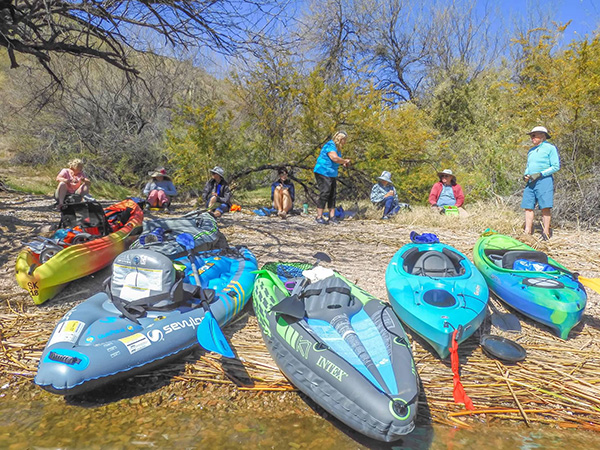 Trailblazers taking a lunch and rest break. [photo by Wayne] |
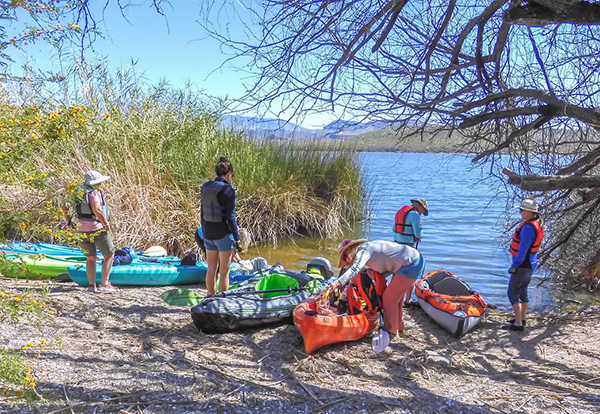 Ready to get back out on the lake once again. [photo by Wayne] |
 Making our way back to Butcher Jones Beach. [photo by Wayne] |
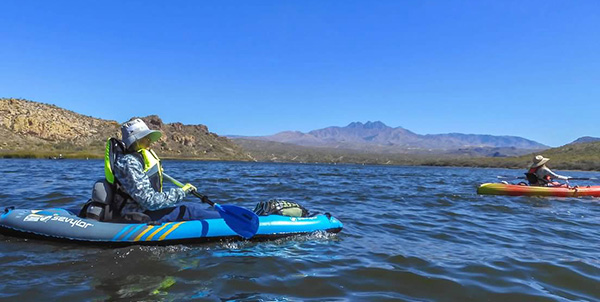 Barbara and Norma are two relaxed kayakers. [photo by Wayne] |
|
The temperature has warmed to the low-70s by this point, a gentle breeze is blowing out of the southwest, and the skies remain a deep clear aqua blue. In such an ideal setting as this, it’s hard to even imagine all the pressing problems and all the human suffering going on in today’s troubled world. But in this place and in this quiet moment we have our own little piece of paradise all to ourselves, if only for a brief time, and all is well—for the time being anyway. By 11:00 AM we slide our kayaks back out into the lake and start paddling toward Butcher Jones Beach. It isn’t too long before we get slammed by still more winds, first at our backs and then in our faces, as it shifts direction. Then we begin to see increasing numbers of both power boats and kayakers on the lake, to the point where this is beginning to look more like a typical Saturday, rather than a Tuesday, on Saguaro Lake. Once again a reminder of spring break. The winds begin to ease by the time we get deeper into the main river channel and canyon. Paddle, paddle, paddle, winds and calm, winds and calm. Paddle, paddle, paddle. Whew! We finally round one last point on the lake and see Butcher Jones Beach, shimmering ahead in the distance. As we get closer, we see crowds of people on a beach that was relatively calm and quite earlier this morning when we launched our kayaks. People sitting in beach chairs, kids and dogs playing in the shallows, families enjoying picnic lunches on the beach, and still more kayakers and paddle boarders coming our way. By 12:30 we’re all back on the beach and carrying our kayaks and gear to our waiting vehicles. Yet another terrific day of kayaking the beautiful desert lakes of southern Arizona. |
 Top of Page
Arizona Trailblazers Hiking Club, Phoenix, Arizona
Comments? Send them to the AZHC .
updated March 26, 2022