
Outdoor Links
Hike Arizona
Trip Planning Guide
Trip Report Index
Calendar of Events
Library
|
Lost Goldmine Trail Superstition Mountains February 26, 2011 by Chuck Parsons |
|
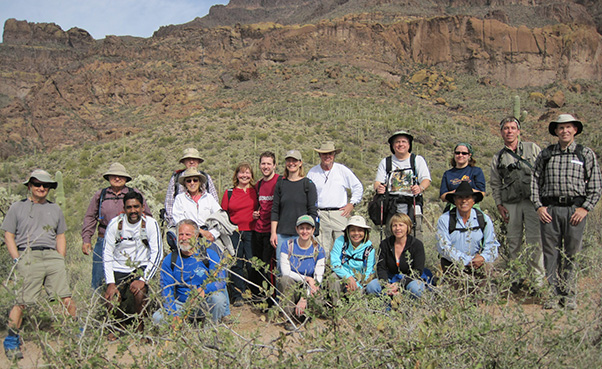 Trailblazers meet in the middle. [photo by Ted] |
||||
|
||||
|
Eighteen Arizona Trailblazers meet roughly midway on the Lost Goldmine Trail for the first time since departing from our meeting location off Power Road and the Superstition Freeway in Mesa. There we split into two separate groups of hikers, one starting from the Cloudview Trailhead at the far west end of the trail and one starting from the Lost Goldmine Trailhead at the far east end of the trail. We stop for a lunch break under partly cloudy skies with a balmy temperature of 60 degrees. The hike begins under somber gray overcast, but the weather people have promised us that any rains would hold off until later in the evening. We’re going to hold them to their word today. |
||||
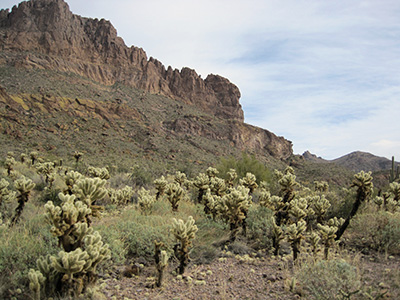 Teddy Bear says, “Won’t you hug me?” [photo by Ted] |
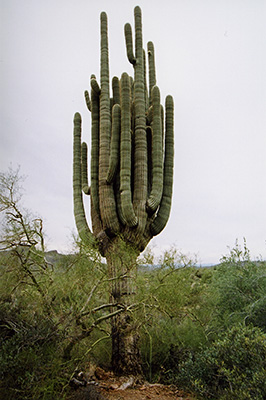 Grand Saguaro on the Lost Goldmine [Chuck] 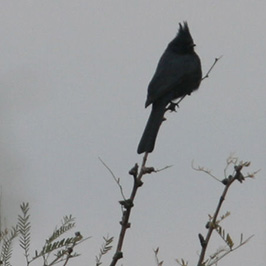 Phainopepla checking his surroundings. [Rob] |
This behemoth is located close to the trail and just a few hundred yards from the Lost Goldmine Trailhead, serving as a prominent landmark to let eastbound hikers know they are now only minutes away from the trailhead. Since these huge saguaros with multiple arms are typically 200 years or more in age, this one was probably well-established with several arms when the Civil War broke out in 1861. Between increased human activity in the area, including mining and free-range cattle grazing in past decades, severe droughts, freezing winter nights, and many desert wildfires over the years, it’s amazing that it has survived these odds in such great shape. We once counted over forty arms on this giant before finally giving up in frustration since they are clustered so tightly towards the center and become hidden from sight that it quickly becomes a lesson in futility. Often referred to as the “black cardinal” because of its profile’s resemblance to the more common and widespread Northern cardinal, including the distinctive crest and long tail, Phainopepla’s range is much smaller, restricted to the southwestern United States and Mexico. It is common throughout the Sonoran Desert of southern Arizona and is easily identified since it’s the only all-black bird with a crest. Males typically fly to heights of 300 feet or more during their elaborate courtship rituals. Rob took this nice silhouette shot of Phainopepla, displaying its distinctive crest against somber gray Arizona skies, within a mile or so of the trailhead. |
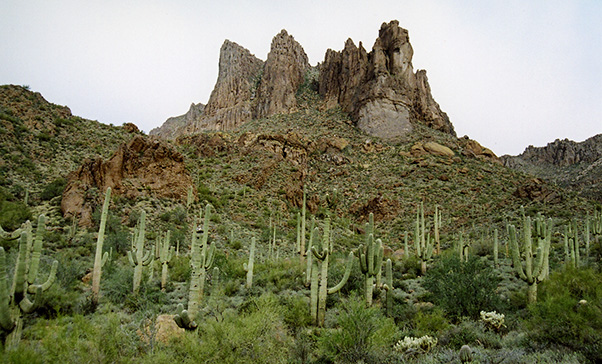 The Superstition Mountains loom over the Lost Goldmine Trail. [photos by Chuck]  |
|
Some of the most pristine desert and spectacular scenery in the Superstition Mountains can be found along the Lost Goldmine Trail, as it meanders along the base and southern face of the Superstitions for almost 11 miles between its junction with the Jacob’s Crosscut Trail and the Lost Goldmine Trailhead off Peralta Road. One of the newest trails in the Superstitions, it was completed in January, 2002, both to ensure continued public access to the area and to preserve and honor the legend and lore of Jacob Waltz and the Lost Dutchman Goldmine. Many a grizzled prospector has spent a lifetime searching for the Dutchman’s gold in the Superstitions and many books have been written and endless tales told over the decades since Jacob Waltz died in 1891, carrying the details and location of the goldmine to his grave. To this day desperate men, driven by the eternal lust for gold, still search in vain for the elusive goldmine. This past year in August of 2010, three more hopeful miners died agonizing deaths in the searing desert heat of mid-summer as they added yet three more names to the long list of unlucky people who have died in the ceaseless search for the fabled Lost Dutchman Goldmine. |
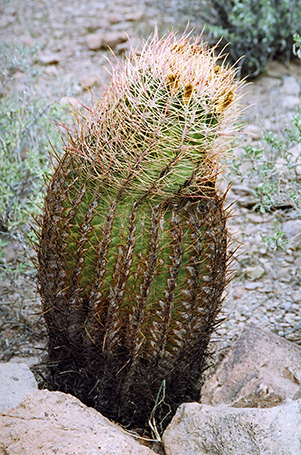 This barrel cactus is in bad need of a haircut. |
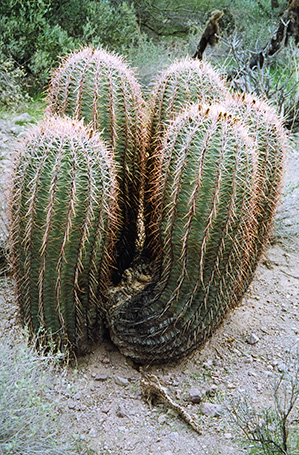 Quintuplets of the sticky and prickly kind. |
| [photos by Chuck] | |
|
We spot these two candidates for strange and bizarre flora to be found along the Lost Goldmine Trail. I’m not sure if the single barrel cactus has simply decided to stand out from its counterparts and be completely different or if there’s some sort of deformity or mutation involved. And we’ve all seen clusters of two or three and even occasionally four barrel cactus growing together out of the same root system, but five sets an all-time record for me. |
|
|
One of the many side benefits of hiking are the unexpected little surprises that await you just around that next bend in the trail or over that next hill. Every hike is a journey of anticipation and discovery. When our two groups finally meet up roughly midway along the trail and break for lunch and the all-important key exchange, the clouds slowly begin to break up and we’re treated to sunshine and blue skies for the first time today. But it was only a sneak preview for Sunday’s weather, and less than an hour later gray skies would prevail once again as each group of hikers make their way to the opposite trailhead. |
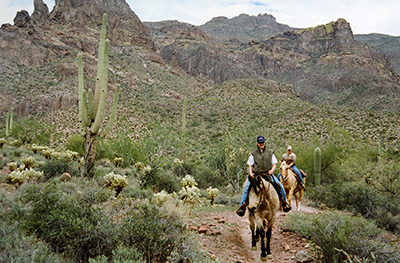 Equestrians and their trusty steeds navigate the Lost Goldmine Trail. 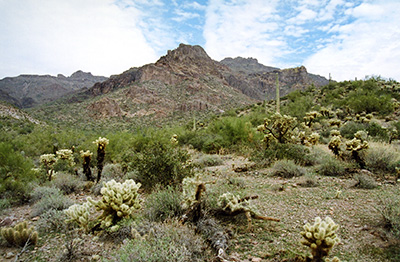 Blue skies over the Superstitions at last! [photos by Chuck] |
|
Meanwhile, Ted told the eastbound hikers stories about the Superstition Ridgeline, Miocene volcanism, and the Lost Dutchman—whose mine they didn’t find. |
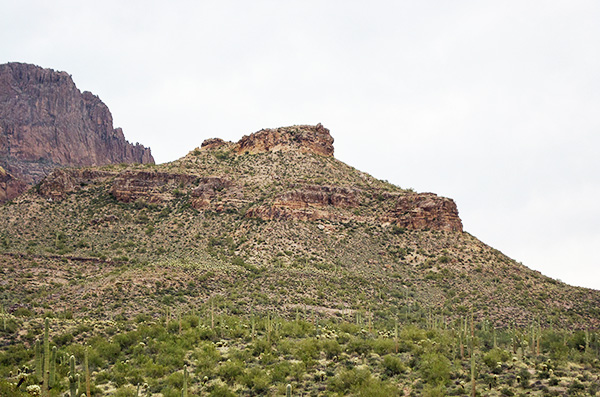 Wedding Cake. [photo by Ted] |
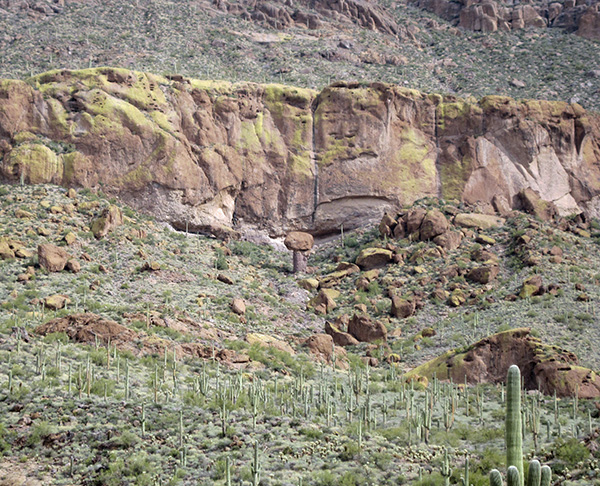 The great stone mushroom. [photo by Ted] |
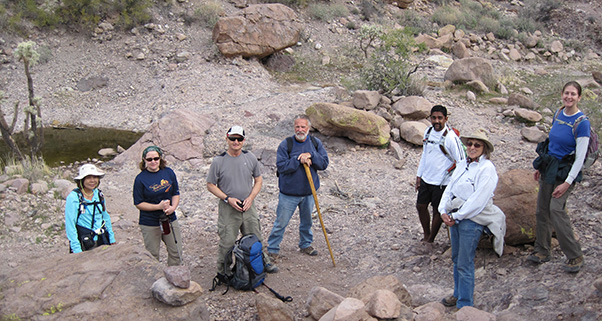 Eastbound hikers find seasonal water by the trail. [photo by Ted] |
 Top of Page
Arizona Trailblazers Hiking Club, Phoenix, Arizona
Comments? Send them to the AZHC .
updated November 23, 2019