
Outdoor Links
Hike Arizona
Trip Planning Guide
Trip Report Index
Calendar of Events
Library
Williams
June 11, 2005
by Chuck Parsons
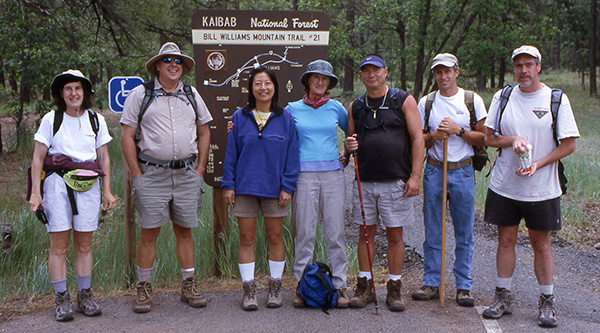 Beth, Joe, Yu-Ling, Kay, Brian, Scott, and Dave at the trailhead. |
|
On a typical hot summer day in mid-June eight refugees from the scorching heat of southern Arizona’s desert country seek relief high on the forested slopes of Bill Williams Mountain near the town of Williams. From left to right Beth Baumert, Joe Michalides, Yu-Ling Langford, Kay Lyons, Brian Cross, Scott Brown, Dave Langford, and hike leader Chuck Parsons (on the other side of the camera lens) gather in front of the Bill Williams Trail #21 sign, with the cool pine/juniper forests beckoning in the background. We breath in the refreshing pine-scented mountain air at 7,000 feet, and all memories of the hot desert we left behind just a couple of hours earlier quickly fade into the deep recesses of our minds. For the rest of this day we are going to immerse ourselves completely into the world of Bill Williams Mountain. |
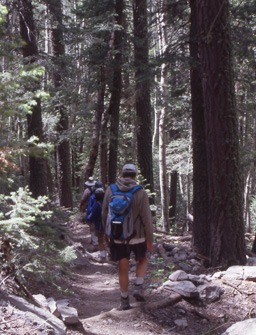 Trailblazers hiking through the tall pines. |
Several Arizona Trailblazers hike their way through the dense forest cover that closes in on much of the Bill Williams Trail, as it snakes its way up the north slope of the mountain, steadily gaining in elevation. We will climb a total of 2,256' in 3.5 miles before we reach the top of this mountain, named in honor of legendary mountain man, trapper, crack shot, and guide, Bill Williams. One of the most colorful and eccentric figures of the old West, legends and stories abound about the man known as “the greatest fur trapper of ’em all.” A hard living and hard drinking man who miraculously survived numerous hair-raising adventures and misadventures, as well as forays deep into hostile Indian country to trade for pelts, Williams finally met his end at the hands of a war party of Utes in 1849 near the Rio Grande headwaters in southern Colorado. |
|
Kay, Yu-Ling, and Joe take a break and enjoy the cool forest cover of aspen, Douglas fir, ponderosa pine, and even a few blue spruce, as we approach the half-way mark in our ascent up the northern slope of Bill Williams Mountain at an elevation of 8,000+ feet. |
 Yu-Ling and Dave take a break on the trail. |
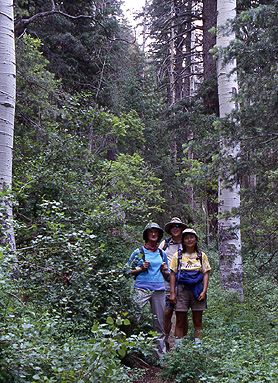 Kay, Joe, and Yu-Ling stop in a mixed forest of pine and aspen. |
|
We keep a close eye on the sky, which has gradually transitioned from mostly sunny to mostly cloudy, spitting occasional light mists through the overhead green canopy. The temperature stands at a delightful 70 degrees, sheer bliss for desert dwellers already weary of triple digits and endless carbon copy weather forecasts calling for more hot and sunny days. The earlier mist eventually builds to a quick, light rain shower that is over before we even have time to think about donning raingear, but just enough to scrub the bracing mountain air even cleaner and add a refreshing charge of ozone as a bonus. |
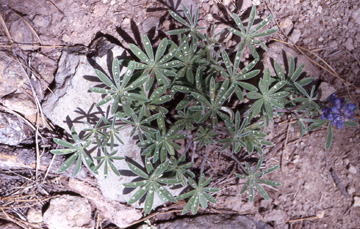 Raindrops reflect the morning sunlight. |
The rest of the day is an interesting display of billowing white cumulus clouds chasing one another across the sky and playing hide and seek with the sun. This ground-hugging lupine manages to catch a number of raindrops within its leaves that soon begin to reflect the sunlight like a string of tiny pearls before evaporating in the heat of the sun. |
|
Sometimes the most fascinating things on the trail are right at our feet, but are often overlooked in our haste to reach our destination. Hiking, like most things in life, is – or at least should be – about the journey, not the destination or the finish line. |
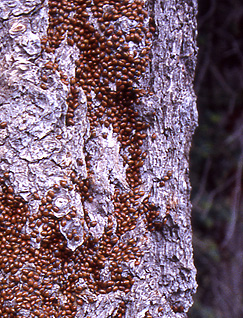 Ladybugs seek a cool refuge in the pines. |
Apparently hikers are not the only ones seeking relief from the heat in Arizona’s high country. During the summer months millions of ladybug beetles can be found on certain mountain peaks in Arizona, concentrating in mass among rocks, boulders, wood debris, and tree trunks. On reaching the top of Bill Williams Mountain, we discover these colorful little beetles taking refuge on the rough bark surface of several large ponderosa pines. Each tree trunk holds tens of thousands of these insects from ground level to as high as one can see in the upper branches. Taking on the skunk’s defense counter measures, these tiny beetles secrete an extremely foul substance if attacked. Most birds learn after one attempt to avoid them at all costs. |
|
The 9,256-foot summit of Bill Williams Mountain bristles with an array of communication towers, in addition to the fire lookout tower silhouetted against the dark sky in this picture. The threatening skies are pushing an advance front of strong gusting winds that blast through the tower support structures, creating an ear splitting shrieking noise that overrides the din from the generators supplying power to the communications equipment. The temperature has been dropping steadily as we approach the summit and added to the wind chill factor on top, we quickly don jackets and flannel shirts to ward off the chill and the wind. Thoughts of a relaxing lunch break on the peak soon vanish, and we only remain long enough to take a few pictures and look around, before heading back down the trail to get away from the wind and the noise. |
 Communication towers against a stormy sky. |
|
As we retreat from this mountain named in honor of the man and the legend, Bill Williams, we are convinced that he would neither understand nor appreciate what modern civilization has done to the top of his mountain; and if he could come back for only a brief visit today, he would no doubt be quite secure in his conviction that he was born in exactly the right period and under exactly the right circumstances. |
 Top of Page
Arizona Trailblazers Hiking Club, Phoenix, Arizona
Comments? Send them to the AZHC .
updated January 20, 2020