
Outdoor Links
Hike Arizona
Trip Planning Guide
Trip Report Index
Calendar of Events
Library
Tonto National Monument
February 19, 2000
by Jeannie Van Lew
|
After paying the required $4 per carload entrance fee, 12 Motorolans joined the Tonto Park Ranger on a tour of the Upper Cliff Dwelling at Tonto National Monument. Those who went were: Tom, Jeannie and Adrienne Van Lew, Julia, Mike and Alicia Staley, Scott King, Dennis Robertson, Peggy and Chuck Giovanniello, Elaine Cobos and Ben Velasquez. |
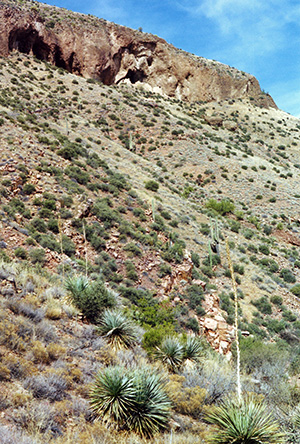 Upper Ruins from the trail. |
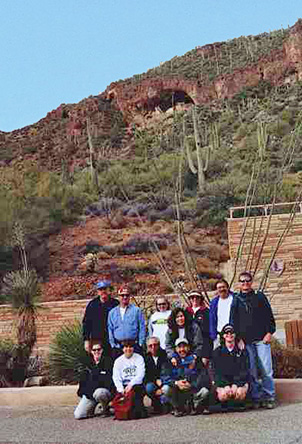 Motorolans at the Visitors’ Center. |
|
The Salado Indians who farmed the Salt River Valley inhabited the cliff dwellings during the 13th and 14th centuries. The Salado Indians occupied this area for three centuries; they made their living from what nature provided in their mountainous terrain. |
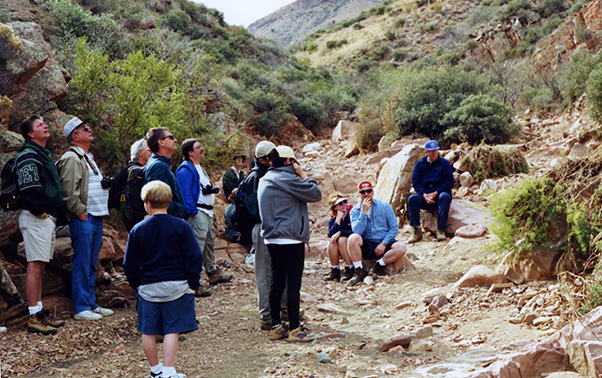 Do you see what I see? |
|
We began our trek on a dirt/rock, 1.5 mile trail, first through the wash and then up the switchbacks that climbed 600 feet to the Upper Ruin, not a hard hike but an interesting and informative one. Our tour consisted of lessons in geology, history, ecology and botany. In the creek bed we learned about the Stromatolite. Some of the earliest known fossils of blue-green algae or bacteria trapped in layers of sediments. |
Along the way we learned that the Salado were farmers. Their pueblo villages dotted the riverside near irrigated fields of corn, beans, pumpkins, amaranth, and cotton. Groups ventured into the hills to hunt and to gather buds, leaves, and roots. A favorite was the fruit of the saguaro cactus, which ripened in the summer. They exchanged surplus food and goods with neighboring tribes, joining the trade network that reached from Colorado to Mexico to the Gulf of California. As the Salado prospered, their numbers increased. They were also fine craftsmen, producing some of the most exquisite polychrome pottery. They made mats and sandals from the fiber of the Yucca. The root provided the Salado people with soap. The Saguaro cactus ribs were used as the ceiling cross pieces, as timber was scarce. The Agave, Mesquite, Saguaro and Prickly Pear all provided food. |

|

|
|
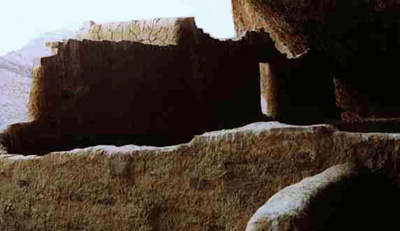
Bonding rocks with mud, the Salado constructed apartment-style dwellings adequate for sleeping, storage, cooking and protection. The Upper Ruin had 32 ground floor rooms, eight with a second story. Terraces and rooftops provided level open spaces for work and play. The surrounding area offered a bounty of useful plants and animals. The dwellings have been so well protected that we could see original roof timbers as well as finger marks in the wall plaster. |
 Top of Page
Arizona Trailblazers Hiking Club, Phoenix, Arizona
Comments? Send them to the AZHC .
updated June 17, 2019