
Outdoor Links
Hike Arizona
Trip Planning Guide
Trip Report Index
Calendar of Events
Library
Sierra Ancha Wilderness
September 19, 2009
by Chuck Parsons
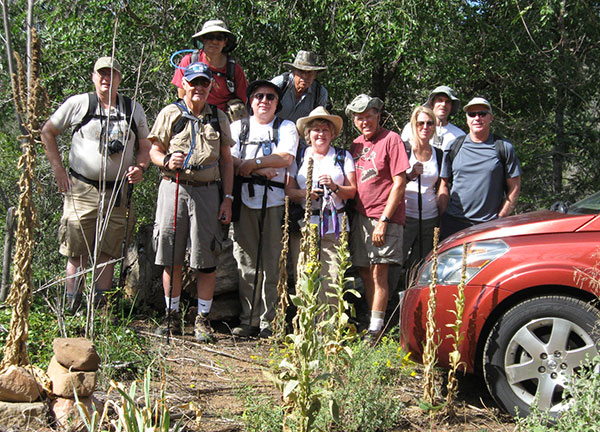 Ten Arizona Trailblazers mug for a group shot at the trailhead. [Bill Zimmerman photo] |
|
Front row, left to right: Michael, David, Chuck, Cyd, Bill Z., Denise,
Bill A. Back row, left to right: Wayne, Rudy, and Brian |
|
Plentiful summer monsoon rains in the Sierra Anchas have encouraged lush plant growth at the trailhead and all along the trail, including these tall sunflower stalks nodding gently in the foreground. A gently winding series of switchbacks carries us up through the thick chaparral, scrub brush, and scattered manzanita that blankets the lower stretches of the Parker Creek Trail. Our starting temperature of 82 degrees at the trailhead belies this late September date and our 5,100 foot elevation. We have to ask ourselves if this summer of 2009 is ever going to end for southern Arizona. The uncomfortable humidity along the trail is also pretty unusual for this time of year. Cooling breezes and dropping temperatures as we gain elevation will surely save the day, or so we hope. |
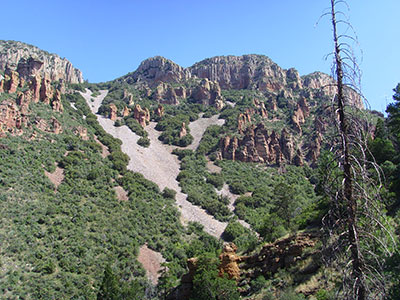 Rock slide among the hoodoos [Cyd Cassel photo]. |
Impressive hoodoos and soaring sandstone cliffs provide the spectacular backdrop along this stretch of the trail. This massive rockslide is one of several that we’ll see along the trail today. We haven’t seen rock slides of this magnitude and scale since hiking to the top of Mt. Humphreys, which probably has the largest such slides to be found anywhere in Arizona. |
|
As we steadily gain elevation along the endless series of switchbacks that carry us higher and higher into the Sierra Ancha Wilderness, the trees become taller as they close in on the trail, the air gradually becomes cooler (and thinner), and the views become even more rugged and spectacular. |
|
Even higher cliffs soar into the deep blue skies over the Sierra Anchas, and towering hoodoos stretch upward as if to meet them. This is the magnificent view that greets us as we continue to climb higher on the Parker Creek Trail. |
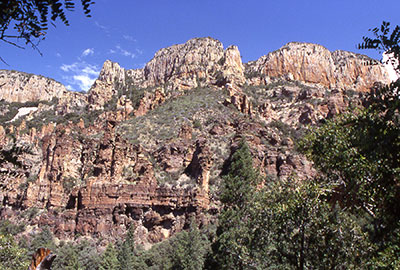 More sandstone cliffs and hoodoos along the trail. |
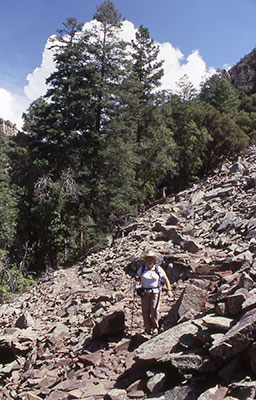 Cyd crossing the rockslide |
Aztec Peak, the highest point in the Sierra Ancha Range, tops out at 7,750 feet. It is nearly 100 feet higher than the highest point in the Four Peaks Range, lying to the southwest on the opposite side of Roosevelt Lake. Cyd carefully picks her way across another large rockslide, one of several such slides that spill across the main trail and beyond. Hiking over this steep jumble of rocks can sometimes be a bit challenging, and you really have to watch your footing to avoid twisting an ankle or taking a bad fall. But most of the Parker Creek Trail is much easier to navigate as it continues to ascend through the Sierra Anchas in a long series of gentle switchbacks. |
|
While Cyd and I take a short lunch break at trail’s edge, we notice this strange looking cluster of snow-white, golf ball sized mushrooms growing on the opposite side of the trail from where we are sitting. Neither of us has ever seen anything like them before in all of our collective years of hiking. |
|
I’ve seen mushrooms of every other color imaginable, ranging from bright cherry red to lemon yellow to jet black, but these pure white mushrooms are completely unique to me. What could they possibly be? We doubt seriously if they are edible and are not about to try them. So Cyd settles for a quick picture for the record before we head back out once again. |
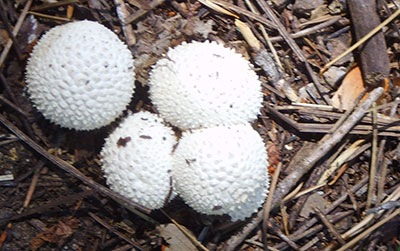 Golf ball mushrooms along the trail [Cyd Cassel photo]. |
|
At first glance, these appear to be small clusters of ladybugs. We’ve seen a number of such clusters before, but on closer examination we discover these to be soft and moist tiny mushrooms that seem to have found the perfect environment at the end of this decaying pine log. |
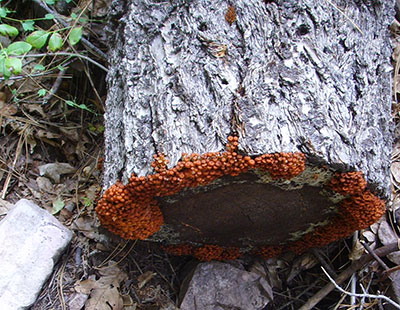 More interesting mushrooms on a rotting log [Cyd Cassel photo]. |
In a perfect example of the endless cycle of life, as one life form in the forest dies and slowly begins breaking down and decaying, it provides a home for some life forms such as these little mushrooms, food and nourishment for other life forms, and in its final act completely breaks down and helps enrich the forest soil for all new plant growth to follow. |
|
This makeshift memorial lies next to the trail close to our turnaround point. It documents the tragic story of an elderly hiker from Coolidge, who somehow got separated from his companions during a day hike in the area and disappeared into the forest without a trace. |
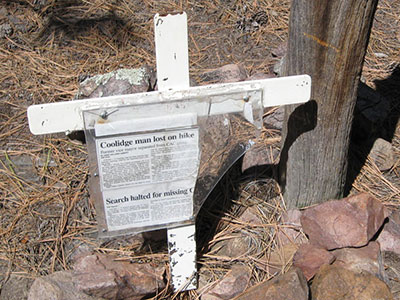 Memorial to a lost hiker [Bill Zimmerman photo]. It’s almost as if their surroundings simply swallowed them up, leaving only grief, mystery, and speculation behind in their wake. |
|
This stunning view can be seen about two and a half miles from the trailhead. From this lofty vantage point the majestic Four Peaks, with Roosevelt Lake lying nestled at their base, is perfectly framed in the narrow canyon opening. This is the best view from the trail of both the peaks and the lake. |
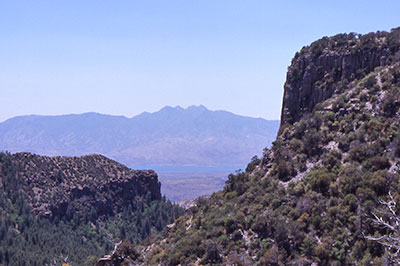 Roosevelt Lake and the Four Peaks |
|
Slippery serpent sightings along the Parker Creek Trail lead to an intense moment of deja vous for this hiker, who is the sole retread from our May, 2006 venture on the Parker Creek Trail. On that memorable hike we encountered what was later identified as a Northern Pacific Rattlesnake close to the trailhead and then a large gopher snake near the end of the trail. Someone in the group managed to get a fuzzy picture of the rattlesnake, but the gopher snake was just too fast for anyone to trip a single shutter and capture the moment. Amazingly, on today’s hike we see both a rattler and a gopher snake again, but in reverse order this time. Hmmm — could it possibly be the same two sneaky snakes? |
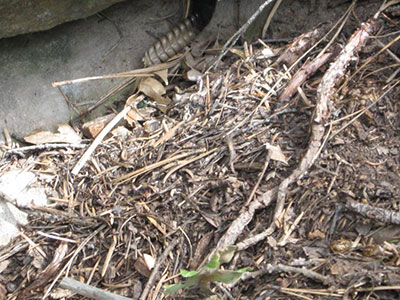 Big, bad rattlesnake beats a hasty retreat [Bill Zimmerman photo]. |
Once again, no one is able to get a single shot of the speedy gopher snake. But Bill Z., one of the fastest camera shooters in the west, manages to get this shot of a rapidly retreating rattlesnake as it makes a mad dash for its burrow beneath a rock ledge. You can count at least ten segments in its tail in the upper center part of the picture, so this must be one big, bad hombre. Lucky for us that he’s on the retreat. |
 Top of Page
Arizona Trailblazers Hiking Club, Phoenix, Arizona
Comments? Send them to the AZHC .
updated September 6, 2016