
Outdoor Links
Hike Arizona
Trip Planning Guide
Trip Report Index
Calendar of Events
Library
Wickenburg
February 12, 2006
by Joe Orman
|
|
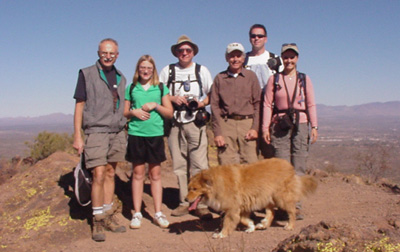
Often the hardest part of a hike is not to carry along our heavy pack, but to leave behind our mental baggage. On this outing to Vulture Peak, I make a conscious effort to see the land as it is, not filtered through the artificial concepts I bring with me. Instead of roads, trails, and cities, I try to get my bearings in terms of ridges, drainages, ecosystems. This is not as easy as it seems; we are programmed to recognize the man-made. I feel compelled to report that the trail was 5 miles round trip, with 1200 feet of elevation gain, and it took us 4 hours. Indeed, such unambiguous terms are necessary for me to communicate the facts, but how do I begin to convey the experience? I can only try. The weather this day is perfect for hiking: clear and unseasonably warm for mid-February. But the land we move though is also unseasonably dry, having gone more than a hundred days without feeling the caress of rain. What a desert garden this must be after a winter of frequent rains! But today, at every turn of the trail we see plants on the defensive: shriveled and shrunk, dormant or dead. We speculate that even the Teddybear chollas, which are dropping their joints in profusion, must be doing so as a last-ditch effort to survive the long dryness. Six people and one dog make up our group of Trailblazers, and all are capable—all negotiate the steep final scramble and make it to peak, even our four-legged friend. The views, as anticipated, are breathtaking. But even on the summit, where the natural landscape dominates the view, the eye is drawn to the man-made: cars crawling along the road below, the cluster of RV's at the turnoff, the buildings of Wickenburg to the north. We pick out the thread of trail we came up, and the distant trailhead where our vehicles wait. This is an inescapable human tendency, to look back the way we came—not only to seek out our own beginnings, but also to reassure ourselves that we know the way back home. The city we came from is lost in the haze far to the southeast, but we know it is there. Probably also due to the drought, what signs of wildlife we see are sparse: a small bird, a lizard, a snakeskin ... but no vultures. History records that these Vulture Mountains, and their highest peak, were named in conjunction with the nearby Vulture Mine—supposedly Henry Wickenburg saw a group of buzzards, or vultures, over the peak on the day in 1863 that he discovered the rich gold deposit. Henry Wickenburg’s influence extended far beyond these mountains: the town of Wickenburg was named after him, and the success of his mine was instrumental in the development of central Arizona and the early growth of Phoenix. But even this, which we think to be the “real” history of the region, is as fleeting and inconsequential as a blink of an eye to the indifferent Earth. The real story of this land is on timescales our minds cannot imagine; the rugged mountain ranges we see are the merest tips of ancient uplifts, remnants and reminders of titanic forces deep within the earth. Gravity, wind and water have worked their way for eons; countless grains of sand have been wrested from these heights to fill the valleys below. All we see are the results, ships afloat on a sea of sand, and it is these we give name to: range, ridge, peak, wash, alluvial fan, bajada. And each range has its own title. Bradshaw Mountains, Sierra Estrella, Saddle Mountain, Eagletail Mountains ... even when I am successful in pointing out these distant mountains, as soon as I speak their names, I am imposing artificiality upon them. Degrees, minutes, miles, names ... these are all Man’s concepts, not Nature’s. The mountains know not their names—their existence, and hopefully our appreciation of them, are independent of the labels. Or, as Shakespeare said, “a rose by any other name would smell as sweet.” The next time I walk into the wilderness, I will try to keep that in mind. |
 Top of Page
Arizona Trailblazers Hiking Club, Phoenix, Arizona
Comments? Send them to the AZHC .
updated July 3, 2019