
Outdoor Links
Hike Arizona
Trip Planning Guide
Trip Report Index
Calendar of Events
Library
|
Granite Mountain Hotshots Memorial State Park A Walk In Their Shoes Yarnell February 25, 2017 by Chuck Parsons |
|
||||||
 Mike, Sandy, April, Eileen, Bobbi, Monika, and Chuck gather around the trailhead sign. [photo by Eileen] |
|
On December 28, 2016, seven Arizona Trailblazers did an exploratory hike on a new trail in a new State Park, located two miles south of Yarnell on Highway 89. Granite Mountain Hotshots Memorial State Park is Arizona’s newest State Park, first opened to the public on November 30, 2016, and dedicated to the 19 members of the elite Interagency Granite Mountain Hotshots wildland firefighting crew, who perished on June 30, 2013, while fighting what came to be known as the Yarnell Hill Fire. We gather around the large dedication sign, located just to the right of a set of metal stairs leading up to the Hotshots Trail, for a quick group picture. But before starting the hike we take a few minutes to study the individual names and faces of the 19 brave members of the Granite Mountain Hotshots crew and read the accompanying article, entitled “To Be – Who We Are”. This article is an open letter to the City of Prescott from Granite Mountain Hotshots Superintendent Eric Marsh, dated March, 2013. |
 Granite Mountain Hotshots Memorial State Park dedication sign. [photo by April] |
|
Eric was one of the 19 Granite Mountain Hotshots killed in the Yarnell Hill Fire just three months after writing this letter. Following is part of that letter. To take the time and the effort to read this letter in full gives one at least a partial understanding and appreciation of just what drives and motivates such highly dedicated men to do a job the vast majority of us would never consider doing or, in fact, would even be capable of doing in the first place. This job requires and even demands a very special breed of men who thrive on hardship and adversity and laugh in the face of extreme challenges and high stakes danger. “Who are the Granite Mountain Hotshots? This is a simple question with a complex answer. We are many things to many different people. To our peers, the other 111 Interagency Hotshot Crews in the nation, we are an oddity. To our city coworkers, we are a bit of a mystery. Guys that work in the woods a lot. To our families and friends, we’re crazy. Why do we want to be away from home so much, work such long hours, risk our lives, and sleep on the ground 100 nights a year? Simply, it’s the most fulfilling thing any of us have ever done. It is difficult to explain the attraction of such a demanding job. It’s just difficult for anyone to grasp the magnitude of suffering and joy that we experience during a given fire season, unless you have been there yourself. When on a fire, we average 16 hours a day on shift, every day, for two weeks. We don’t have bathrooms or showers and we eat a lot of bad food. We love it. We are proud and passionate about our program. We don’t just call ourselves hotshots, we are hotshots in everything that we do.” |
|
Now flash forward to February 25, 2017, and 19 members of the Arizona Trailblazers Hiking Club gather around the new Granite Mountain Hotshots Memorial State Park sign next to the highway. The time is 9:00 AM on a beautiful Saturday morning as we strike out from the trailhead under a brilliant blue sky with a bracing temperature of 40 degrees. The Hotshots Trail begins from the parking lot at 4,318 feet with a small set of metal stairs and then begins to climb in earnest through a long series of switchbacks for the next 2.85 miles before terminating at the Observation Deck at 5,460 feet. |
 The Hotshots Trail. [photo by Wendy] Between the afternoon and evening hours of Friday, June 28, 2013, as summer monsoon thunderstorms rolled through the area, lightning had ignited seven small blazes in the mountains around Prescott. One of those lightning strikes ignited a brush fire in the thick chaparral choking an isolated ridgetop in the Weaver Mountains just to the north of the town of Yarnell, Arizona. This fire would later come to be known as the Yarnell Hill Fire. |
 Trailblazers gather in the trailhead parking area. [photo by Carl] |
 Mark and Kat. [photo by Carl] |
 Carol [photo by Carl] |
 Ann, Tom, Monika, Michelle [photo by Carl] |
 Carol, Wendy, Monika, Mimi, and Kat study the trailhead sign. [photo by Ann] |
 Park Ranger Gonzales gives us a brief overview of the Hotshots Trail. [photo by Ann] |
 Ranger Gonzales points out the Fatality Site. [photo by Carl] |
|
Most people wouldn’t consider such brush fires a serious threat, but experienced wildland firefighters have learned to respect and fear these types of chaparral wildfires since dry chaparral is essentially a tinderbox waiting to explode and resulting in a fire that can burn both rapidly and very erratically. A large poster hanging on the wall of the Ready Room in Prescott’s Station 7, new headquarters for the Granite Mountain Hotshots Crew, serves as a grim reminder for the men of these types of highly unpredictable chaparral wildfires. This poster has pictures of the 1949 Mann Gulch Fire in Montana that resulted in 13 hotshot fatalities, as well as the 1994 South Canyon Fire in Colorado that resulted in 14 fatalities. In both of these cases highly skilled and experienced wildland firefighters were burned to death after being caught completely off guard, with no time to escape, while fighting relatively small wildfires that grew with terrifying speed and erratic shifts in direction. |
 19 Arizona Trailblazers pose for a group picture at the new State Park sign. [photo by Wendy] L to R: Monika, Lin, Carl, Kat, Ken, Emma, Mark, Dave, Biljana, Michelle, Carol, Tom, Mimi, Laurie, Wendy, Ann, Ralph, Diva, Chuck |
|
At roughly 600 foot intervals, from the trailhead all the way up to the Observation Deck 2.85 miles ahead, 19 polished black granite plaques are anchored to the large granite boulders along the trail. Each of these 19 plaques is dedicated to one of the 19 fallen Hotshots, with a picture and a brief background history of each man. Most of these men were in their 20s and 30s at the time of this tragedy, many with wives and small children. On one of these plaques we see this inscription: “Dream as if you will live forever, live as if you will die tomorrow.” This is more or less the motto that each of these Granite Mountain Hotshots lived and died by. The one common thread that connects every single one of these men is a driving passion, dedication, and commitment to their families, their fellow hotshots, and their work. And more than a few of these men were devoutly religious. |
 Typical plaque placement, anchored to the granite boulders lining the trail. [photo by Wendy] |
|
We soon hit the first set of steps carved into solid rock, the first of over 200 steps carved into the rock that help hikers navigate through and over some very rugged and challenging terrain in these Weaver Mountains. At several intervals along the trail Ralph and I stop to discuss the fire and try to imagine the extreme difficulties and challenges that faced the Granite Mountain Hotshots as they battled the Yarnell Hill Fire on that hot day in June, four years ago. |
 Eric Marsh, Superintendent of the Granite Mountain Hotshot Crew. [photo by Wendy] |
 Travis Turbyfill, Granite Mountain Hotshot. [photo by Wendy] |
 Wade Parker, Granite Mountain Hotshot. [photo by Wendy] |
 Garret Zuppiger, Granite Mountain Hotshot. [photo by Wendy] |
 This one picture says it all and says it perfectly. [photo by Wendy] |
|
This hike is challenging enough for most of us Arizona Trailblazers today, but this is a cool and comfortable day in late February, we have an actual well-maintained trail to hike, and we’re only carrying a minimal amount of gear and water. The Granite Mountain Hotshots and all the rest of the wildland firefighting crews were faced with temperatures exceeding 100 degrees on that scorching hot late June morning, with little or no shade, they had to literally bushwhack their way through these rugged mountains, and they were each carrying forty or more pounds of bulky gear including chain saws, shovels, Pulaski’s and various other tools of the trade, in addition to as much as four gallons of water. Six of the seven brush fires were quickly knocked down by wildland fire crews, but the stubborn Yarnell Hill Fire wouldn’t yield so easily. By the time it grew to 100 acres, it was given high priority status. The fire incident commander, in charge of coordinating all major activities relating to fighting the fire, set up headquarters at the volunteer fire station in Yarnell and started ordering additional resources as rapidly as possible — eight engines, two air tankers to fight the fire from the air, structure-protection specialists, and three hotshot fire crews. Granite Mountain was one of those crews. At 5:15 A.M. on Sunday morning, June 30, the Granite Mountain Hotshots crew begin arriving in the Ready Room of Station 7 to await their assignments at the morning briefing. Superintendent Eric Marsh informed the crew that the Yarnell fire had grown to over 300 acres in size. It was still confined to thick chaparral on the ridgetop and would be a very hot fire to fight under extremely rugged conditions. Chaparral is a mix of scrub oak and brush that grows so dense it’s a major struggle just walking through it, much less fighting a raging wildfire chewing its way through it. |
 Laurie leads the charge along this stretch of the Hotshots Trail. [photo by Wendy] |
 There’s a good photo op along this switchback turn. [photo by Tom] |
 Trailblazers almost disappear in a sea of mammoth boulders. [photo by Carl] |
 Carol and Tom, with the valley far below in the hazy distance. [photo by Ann] |
 Diva and Wendy pause to read one of the trailside dedication plaques. [photo by Ann] |
 A dead tree stretches its branches forlornly toward the sky. [photo by Carl] |
 Another charred victim of the fire. [photo by Diva] |
 Rebirth in the midst of death and destruction. [photo by Diva] |
 This hapless prickly pear cactus was burned to a crisp. [photo by Ralph] |
 Ken and Carol study one of the trailside signs. [photo by Tom] |
 Kat and Monika pause briefly. [photo by Tom] |
 Carol, Monika, and Ken. [photo by Tom] |
 Trailblazers tackle yet another switchback. [photo by Carl] |
 Ann, Chuck, Diva, and Wendy take a short break. [photo by Ralph] |
|
The first four switchbacks on the Hotshots Trail are the longest of the many switchbacks encountered on the hike up to the Observation Deck, almost reminding us Grand Canyon backpacking veterans of the infamous Jacob’s Ladder switchbacks on the upper section of the canyon’s Bright Angel Trail. It’s not too bad at all hiking down into the canyon, but seemingly never-ending and a little discouraging on the hike back out with what seems to be an extra 25 or more pounds of extra weight in your backpack. You have to be a canyon backpacker to appreciate this bizarre phenomenon known as phantom pack weight. |
 Biljana can still manage a smile. [photo by Carl] |
 Emma looks back at her mom. [photo by Carl] |
 Dave gets ready to snap the perfect picture. [photo by Carl] |
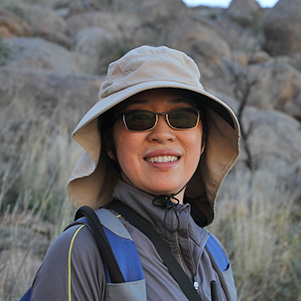 Lin always has a perfect smile for the camera. [photo by Carl] |
|
The next set of switchbacks on the Hotshots Trail is much shorter, and after that they gradually become even shorter and easier to navigate as we continue to gain elevation on the trail. Roughly a half mile or so before reaching the Observation Deck the trail finally begins to level off and the hiking is much easier from here on. We eventually round a bend in the trail and see the small town of Yarnell lying below us to the east. Between the trail and Yarnell, the Fatality Site also comes into view for the first time. Looking down on this site, still far below us in the distance, it gradually starts to sink in that this is the exact spot where the 19 Granite Mountain Hotshots fell victim to the Yarnell Hill Fire, as they made a last desperate stand against the fire and lost. That feeling will become even stronger as we prepare for the 400-foot descent on the Journey Trail and get closer and closer to the site. |
 Ken and Emma take a break at the Observation Deck. [photo by Ann] |
 Trailblazers take a break before descending the Journey Trail. [photo by Tom] |
 A last glance at hikers gathered around the Observation Deck. [photo by Ann] |
By 8:00 AM, the Hotshots crew had moved to the Yarnell volunteer fire station for further briefing. The fire was by now divided into eastern and western divisions, with the Granite Mountain crew assigned to the western division. The men were all told to call their families, standard procedure whenever going in to fight remote wildfires. By 10:00 AM the temperatures had already soared to over 100 degrees, as the crew reached the fire and immediately went to work creating a large fire break by clearing a wide swath of vegetation around the fire’s leading edges, depriving it of all flammable fuels. Later that day sustained winds of 25 mph, in addition to the effects of long-term drought in the area and temperatures exceeding 100 degrees, caused the fire to rapidly grow from 300 acres to over 2,000 acres. By 3:00 PM the fire started moving quickly to the north toward the small town of Peeples Valley. Later on that Sunday afternoon another large monsoon thunderstorm was brewing in the area, with shifting wind gusts as high as 50 mph. This would eventually cause the fire to rapidly switch directions, making it even more dangerous and unpredictable for the firefighters to deal with. Then suddenly and without warning, the gusting winds shifted a full 180 degrees and begin to rapidly push the fire straight toward the town of Yarnell. |
 Several sections of the Journey Trail are filled with thick mud. [photo by Wendy] |
We’ve become pretty well scattered along the Hotshots Trail, with most hikers stopping from time to time to read the 19 granite dedication plaques along the side of the trail, as well as the other interpretive signs along the way providing information about wildland firefighting. So we reach the Observation Deck, the highest point on the trail at 5,460 feet, in waves. From here most of us take a short break and read several more interpretive signs before beginning the 3/4 mile Journey Trail down to the Fatality Site, 400 feet below. This trail didn’t actually exist at the time of the fire, but it tracks the last footsteps of the Granite Mountain Hotshots as they made a desperate scramble down this steep, rocky slope to make their last stand against a fire now raging totally out of control, as it becomes supercharged by gale force winds, extreme heat, and a bone dry landscape – a converging of ideal conditions for the perfect firestorm. Theirs was truly a race against time and time was not on their side. |
 The story of the Hotshots. [photo by Chuck] |
 Background history of the Granite Mountain Hotshots. [photo by Tom] |
 The Yarnell Hill Fire timeline. [photo by Chuck] |
 The tragic story of the Granite Mountain Hotshots final journey. [photo by Chuck] |
By 3:50 PM Granite Mountain Hotshots fire lookout Brendan McDonough (affectionately called Donut by his fellow Hotshots), who was keeping in radio contact with the rest of his crew and periodically updating them on the fire’s progress, was finally forced to abandon his lookout post as the shifting winds caused the fire to rapidly advance on his position. McDonough eventually made his way toward one of the crew vehicles and drove toward Yarnell with several other firefighters. By 4:22 PM all firefighters were forced to disengage from the fire line just outside of Yarnell and shift their efforts toward assisting in the full evacuation of the town. |
 First view of the Fatality Site (small circle at bottom of picture) and Yarnell. [photo by Tom] |
 The Fatality Site in late December, blanketed by snow. [photo by Chuck] |
 The Fatality Site, with Yarnell in the background. [photo by Wendy] |
Meanwhile, as they were taking a well-deserved lunch break on a ridgeline high above Yarnell, the 19 other members of the Granite Mountain Hotshots crew were watching these events unfold with growing apprehension. Do they hunker down in the relative safety and security of their current position, or do they take their chances and try to make their way down the mountain and make a last attempt to save additional homes and structures in the Yarnell area before it was too late? By both training and basic instinct, Hotshot crews are not in the habit of sitting idly by and watching houses and other structures burn to the ground, so it didn’t take them long to reach a decision and make their move. Superintendent Eric Marsh radioed that his crew was starting down the mountain and working their way toward Yarnell – first in their crew vehicles as far as they could go and then later on foot in the direction of the Boulder Springs Ranch, about a half-mile west of the main part of town. Coming off the ridge, they began a hasty descent through heavy chaparral and rough, rocky terrain on what is now the Journey Trail and ended up in a large basin surrounding on three sides by huge granite boulders. From this position they could not see the fire at all and felt somewhat protected. |
|
There’s no question that in their final moments together, as the 19 Granite Mountain Hotshots made a last desperate stand by deploying their standard fire shelters, in addition to surviving, they were thinking mostly about their families and close friends. But more than a few were no doubt also praying and thinking to themselves those comforting words from the Twenty Third Psalm that dominate the thoughts of so many people during their last moments on Earth: The Lord is my shepherd; I shall not want. He maketh me to lie down in green pastures; He leadeth me beside the still waters. He restoreth my soul. He leadeth me in the paths of righteousness for His name’s sake. Yea, though I walk through the valley of the shadow of death, I will fear no evil; for Thou art with me, thy rod and thy staff they comfort me. ... Surely goodness and mercy shall follow me all the days of my life; and I will dwell in the house of the LORD forever. |
 Fatality Site with a memorial flagpole to the left. [photo by Carl] |
 Closer view of the Fatality Site. [photo by Wendy] |
 This charred tree in the middle of the site speaks volumes. [photo by Ralph] |
 19 gabions, united by chains, represent the eternal team. [photo by Wendy] |
|
The Yarnell Hill Fire would become the deadliest wildfire in the history of Arizona and resulted in the highest wildland firefighter death toll in the United States since the 1933 Griffith Park Fire in Los Angeles that killed 29 wildland firefighters. After it was all over, 8,400 acres, or 13 square miles, and 114 structures ultimately burned to ash in the fire. But within minutes a towering wall of fire exploded from behind the large ridge just to the east of the crew. Another fire was rapidly chewing its way up through the large slope of chaparral they had just come through. The crew sought out the lowest depression on the basin floor where the brush was thinnest and quickly went to work deploying their fire shelters, according to Eric Marsh’s last radio transmission from their final position at 4:41 PM. Then within seconds violently shifting tornado-like winds totally surrounded the crew with swirling curtains of raging flame, cutting off all possible escape routes. At one point members of the Blue Ridge Hotshots attempted a daring and risky rescue mission to free the entrapped Granite Mountain Hotshots, but they were driven back by the intense flames and heat of the fire. Exactly what happened next is known only to God. It was almost 90 minutes before an Arizona Department of Public Safety helicopter located the Hotshots through the remaining flames and heavy smoke and dropped a paramedic in a safe location several hundred yards from the scene. Within minutes of arriving at the site and checking each man’s pulse, the medic radioed the following brief message: “I have 19 confirmed fatalities.“ Of the 19 fire shelters, 14 had been partially vaporized by the intense heat or completely ripped to shreds by the high winds, while the other five were barely recognizable as fire shelters. Everything in the basin was charred, blackened, and burned to ash. The heat from the fire was so intense that it even cracked many of the massive granite boulders surrounding the site, like so many fragile eggshells. Thanks to Kyle Dickman, Associate Editor of Outside magazine, for the wealth of information provided in his article “The True Story of the Yarnell Hill Fire” which I used throughout this trip report in describing the hour by hour account of the fire and the Granite Mountain Hotshots’ valiant efforts to extinguish it. |
 Wendy, Mimi, Ralph, Diva, and Chuck take a short break. [photo by Wendy] |
 19 iron crosses mark the exact spot where each Hotshot fell. [photo by Wendy] |
 Small Native American-inspired memorials sit atop each gabion. [photo by Wendy] |
 A Granite Mountain Hotshots T-shirt and other mementos honor their sacrifice. [photo by Wendy] |
 Inscripted stones mark this gabion, standards that each Hotshot strived for. [photo by Wendy] |
 May you rest in peace, Hotshot Jesse Steed. [photo by Wendy] |
 Honoring the Hotshots at the base of the memorial flagpole. [photo by Wendy] |
 Ralph stands next to one of the 19 gabions at the Fatality Site. [photo by Wendy] |
|
On a lighter note, we have a birthday boy among us today, as Ralph celebrates his 39th (can that be right??) birthday on this day, February 25. I don’t really know and I’m certainly not going to challenge it, but Ralph looks a bit older than 39 to me. Then again, some people don’t show their age. Had I known, I would have baked you a cake Ralph. But at least Diva did bring a lemon-flavored Lara Bar and a small candle with her to celebrate the occasion. We struggle to light the candle, and a Lara Bar is certainly no substitute for a real birthday cake, but it’s the thought that counts. Anyway, Happy Birthday, Ralph! |
 Diva helps Ralph celebrate his birthday. [photo by Wendy] |
 The Lara Bar “birthday cake”. [photo by Wendy] |
|
After the hike several people decide to call it a day and head for home, while the rest of us discuss post-hike lunch options, always a major consideration after a demanding hike or, for that matter, any hike. Someone finally suggests a little-known restaurant, NicholsWest, in the tiny town of Congress just down the road at the junction of Highways 71 and 89. Just about anything sounds good when you’re almost hungry enough to eat boiled boot leather, so we point our vehicles down the road and head for Congress. |
 Wendy, Ralph, Chuck, and Mimi head back to the trailhead. [photo by Diva] |
 Trailblazers making their way back down the trail. [photo by Tom] |
 Mimi studies a line of charred and dead trees. [photo by Wendy] |
 One of several sturdy steel benches along the trail. [photo by Wendy] |
 We’re in the home stretch now, with the parking lot just below. [photo by Wendy] |
 Kat, Ralph, Diva, Chuck, Mimi, Carol, and Wendy. [photo by Diva] |
 Chocolate Mousse Cake in on the menu today. [photo by Carol] We all agree that the delicious and even slightly decadent gourmet sandwiches at NicholsWest are just about the best any of us have ever had anywhere, while the deserts are literally to die for. So the next time you find yourself in Congress, Arizona, and even just a little hungry be sure to drop in at NicholsWest for the culinary surprise of your life. You won’t be disappointed. We guarantee it. |
 Wendy, Kat, Mimi, Carol, and Chuck. [photo by Tom] |
 Ann, Laurie, Monika, and Tom. [photo by Wendy] |
 Studying the menus. It’s a tough choice. [photo by Wendy] |
 Hmmm, let’s see here. What do you think about this one, Carol? [photo by Wendy] |
 Famished Trailblazers dig in. [photo by Ann] |
 NicholsWest Restaurant in Congress. [photo by Wendy] |
|
I imagine there are very few people who can hike this trail, especially for the first time, without experiencing some sort of emotions and feelings for these 19 young men who died in the line of duty fighting the Yarnell Hill Fire. We wouldn’t be human if we didn’t have these emotions and feelings. Even though I did this as an exploratory hike with some friends last December, I don’t mind admitting that even on my second hike I still had to fight back a few tears from time to time, especially as we hiked the short Journey Trail down to the Fatality Site itself where the 19 Hotshots made a desperate last stand against the fire and perished. And I imagine this was true for each and every one of us during the hike today and for most other hikers who tackle this trail as well. This last stretch of the Journey Trail down to the 19 iron crosses and the 19 gabions that mark the exact spot where the 19 Hotshots fell could just as well be called the trail of tears since this now hallowed ground is unquestionably becoming soaked with the tears of passing hikers overcome with emotion and grief and will continue to be for many years to come. But this trail and this hike held an even greater meaning and significance for one of our hikers today, Ralph Glenn, a 35-year firefighting veteran visiting this site for the first time. I asked Ralph if he would mind putting down into words just what this hike meant to him, personally, from his prospective as a long-time firefighter, both urban and wildland, and former Captain of a California Hotshots crew for 17 years. Here is what Ralph had to say: ”Dream as if you will live forever, live as if you will die tomorrow.” This is the motto one of the Granite Mountain Hotshots lived and died by. I was a firefighter for 35 years. I was a Captain of a hotshot crew the final 17. It was a fulfilling career. I occasionally felt that I made a difference in people’s lives. Once when my crew saved 23 homes in the worst fire in Orange County history, the Laguna Beach Fire. But in general I worked long strenuous hours and was grateful to be in the outdoors. Yesterday, emotions that I do not understand flooded my being. I hiked the 7 miles, with 18 friends, to the Granite Mountain Hotshots Memorial. 19 firefighters perished here on June 30, 2013, in the Yarnell Hill Fire. They gave the ultimate sacrifice in an attempt to save homes in Yarnell, AZ. Chuck Parsons, our hike leader, asked me to express my feelings of this extraordinary experience. I am sorry I cannot find the words. I just cried. Thanks Chuck,Ralph Glenn |
 Top of Page
Arizona Trailblazers Hiking Club, Phoenix, Arizona
Comments? Send them to the AZHC .
updated March 15, 2017